New AI cameras providing Bay Area researchers insight into gray whale behavior

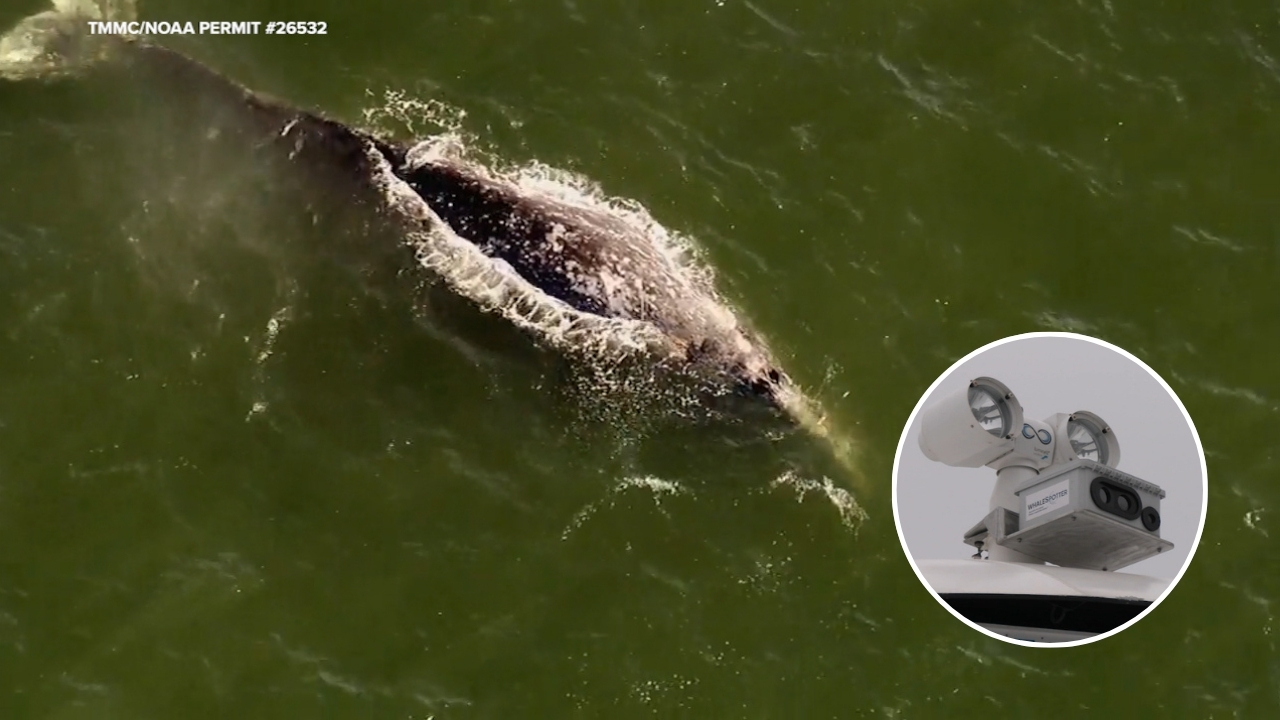
SAN FRANCISCO (KGO) -- As a San Francisco ferry boat captain, Dillon Donnelly is always keeping an eye out for whales in the Bay. And for much of the year, he's rarely disappointed.
"During whale season it'll be daily. So daily, hourly and they kind of linger they move are and different pods come in," Donnelly says.
But now, Captain Donnelly has a what amounts to a second set of eyes. A thermal camera mounted above the bridge of the Lyra. The device is part of a new whale spotting system that includes two more cameras mounted on Angel Island, which we first showed you last month.
The cameras detect heat changes generated when whales surface sightings are relayed to vessels on the Bay to help captains avoid deadly collisions. SF Bay Ferry's Lexi Matsui says the system is being deployed at a critical time, as more Humpback, and now gray whales are finding their way into the Bay.
RELATED: San Francisco turns to AI to avoid collisions between ships, whales searching for food
"So as we're seeing more and more whales every year, we're seeing more. Every season is getting busier. The seasons are lengthening in a way that we haven't seen. So those patterns are more unpredictable than they used to be. And it's really important to us to keep them safe while they're here and figure out a way to help other vessels do the same," says Matsui.
Across the Bay at the Marine Mammal Center, images and data are already streaming in. With gray whales detected every single day for 48 days straight - within hours of the cameras being turned on.
Providing a treasure trove of information for marine researchers like Kathi George, who monitors whale populations in San Francisco Bay. She says research teams have been tracking an influx off gray whales over the last decade.
"This year, we were able to photo identify at least 16 individual gray whales. And two of those whales have been in the bay and observed for over 100 days, which is pretty amazing," says George.
The new camera system is part of a growing safety net of overlapping technologies. Several years ago, researchers from the Benioff ocean science laboratory deployed specialized audio-buoys that essentially eaves drop on the sound of passing whales, to detect their presence. Project Scientist Rachel Rhodes believes combining the data will not only keep whales safer, but could help unlock mysteries of changing migration patterns.
MORE: Concerns grow over more gray whale deaths in Bay Area and climate change's contribution

"You know, there are so many questions left unanswered. And a lot of work ahead on understanding why are these whales coming into the Bay? Are they feeding? What are they feeding on? Sort of, you know, where are they spending their time? All of these are things that I think everyone wants to look more closely at," says Rhodes.
Scientists believe melting ice sheets in the arctic may be disrupting the food chain and changing Gray Whale behavior. The whales typically feed in the icy waters before starting their journey south to breeding grounds in Mexico. Kathi George says some Grays are now straying into the Bay for extended lengths of time
"So, they have less than full in their gas tanks, and they typically don't eat on that entire migration south and back north. And what we're seeing is that they are finding other ways that they could try to get some food. And we've been hearing similar stories from other places along the coast," George adds.
She says the cameras, paired with artificial intelligence, are already helping researchers to better track the whales at night, and in bad weather. Building a more complete picture of their excursions into San Francisco Bay.
And as if to underscore how unpredictable the science is, the gray whale season has now technically ended, but the Marine Mammal Center says even so, a late wanderer was just spotted entering San Francisco Bay.

.