Musk v. Altman live updates: Closing arguments after testimony wraps up, deliberation ahead

ByABC7 Bay Area Digital Staff and Frances Wang KGO logo
Last updated: Friday, May 15, 2026 12:29AM GMT
Musk v. Altman: Last day of testimony in the liability phase

OAKLAND, Calif. (KGO) -- Technology tycoons Elon Musk and Sam Altman are facing off in a high-stakes trial revolving around the alleged betrayal, deceit and unbridled ambition that blurred the bickering billionaires' once-shared vision for the development of artificial intelligence.

The trial centers on the 2015 birth of ChatGPT maker OpenAI as a nonprofit startup primarily funded by Musk before evolving into a capitalistic venture now valued at $852 billion.

The civil lawsuit accuses Altman, OpenAI's CEO, of double-crossing Musk by straying from the company's founding mission to be an altruistic steward of the technology.

Key Headlines

Here's how the news is developing.
ByFrances Wang KGO logo
May 15, 2026, 12:29 AM GMT

Closing arguments end in Musk v. Altman trial; jurors begin deliberations Monday

Closing arguments wrapped Thursday in a high-profile trial involving Elon Musk and OpenAI, capping more than 10 days of testimony.

Closing arguments wrapped Thursday in a high-profile trial involving Elon Musk and OpenAI, capping more than 10 days of testimony that exposed private journals, text messages and tense exchanges among prominent figures in tech and artificial intelligence.

Attorneys on both sides delivered lengthy presentations in what has been the longest day in court so far, using vivid metaphors to frame their cases for jurors. Outside the federal courthouse, protesters, again, gathered as they have throughout the trial, warning that regardless of the outcome, they view artificial intelligence as a threat to humanity.

Inside the courtroom, Musk's legal team urged jurors to question the credibility of OpenAI CEO Sam Altman. They asked jurors to imagine crossing a wooden bridge over a deep gorge, and whether they would trust it if it were built on what they called "Sam Altman's version of the truth."

Altman's attorneys countered with their own imagery, arguing that Musk wants jurors to believe his donations came with conditions attached, leaving OpenAI "tied in knots" as it sought to fulfill its mission.

The judge emphasized that jurors must focus on the legal issues at hand, not the high-profile personalities or public attention surrounding the case. The claims under consideration are breach of charitable trust and unjust enrichment.

Musk's attorney made a final appeal, telling jurors that Altman "can't be trusted." In response, Altman's attorney argued that even people close to Musk, including the mother of his own children "can't back his story."

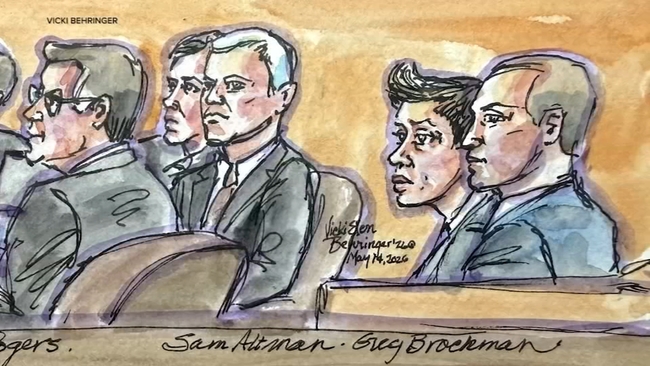
Defendant Greg Brockman mostly kept his eyes locked on the attorneys, while Altman often looked down at the floor.

Musk was not present in court Thursday, as he is in China as part of a U.S. delegation with President Donald Trump for high-level meetings. His attorney thanked jurors on his behalf, saying Musk is "tremendously passionate" about the case.

In closing remarks, the defense pointed to co-defendants Altman and Brockman seated in the front row, saying, "Mr. Musk isn't here.," adding that the only witness testimony Musk was present for was his own. "And he hasn't been seen since."

The defense also highlighted the statute of limitations as part of its argument.

Attorneys for both parties have spoken to reporters after court sessions, but declined to comment Thursday, saying they would let their closing argument stand on its own and respect the judicial process.

Jurors are advisory in this trial, so the final decision in the case will ultimately rest with the judge.

The trial has drawn attention, not only for its legal implications, but also for the broader questions it raises about the future of artificial intelligence and the responsibilities of those shaping it.

Gloria Rodríguez Image
May 14, 2026, 2:53 PM GMT

Closing arguments after testimony wraps up, deliberation ahead

Closing arguments in a high-profile trial involving tech leaders Elon Musk and Sam Altman are set to begin Thursday in Oakland, marking a pivotal moment in a case that has drawn significant attention.

Attorneys for both men will make their final presentations to a jury after weeks of testimony in a dispute centered on the direction and mission of OpenAI.

Elon Musk, one of the central figures in the case, is not expected to be present in court. Musk was seen in China with President Donald Trump on Wednesday morning, a development that surprised many at the courthouse.

Musk concluded his testimony two weeks ago and has not appeared in the courtroom since. At the time, the judge allowed Musk to leave but did not formally excuse him from the trial. His recent international travel raised questions because he remains subject to recall as a witness.

Marc Toberoff, an attorney for Musk, downplayed concerns about his absence.

"Unless there's been a court order that a witness is on or, on recall cannot travel. Then, as far as I know, the witness can travel. I believe it's a it's a non-issue," Toberoff said.

William Savitt, an attorney representing OpenAI, expressed surprise at Musk's decision to travel abroad.

"It was surprise to see the witness, subject to recall, in the case he is plaintiff...decide to get on Air Force 1 go to China," Savitt said.

The trial centers on Musk's lawsuit against OpenAI, in which he alleges that Altman and other leaders abandoned the organization's original nonprofit mission. Musk claims the company shifted away from its foundational principles.

Altman, in turn, has accused Musk of attempting to undermine OpenAI and its ChatGPT technology to benefit his own artificial intelligence ventures.

Testimony in the case wrapped up Wednesday. The case could go to the jury as soon as Thursday or as late as Monday. Court is not in session on Fridays.

Bay City News logo
May 14, 2026, 2:46 PM GMT

Last day of testimony before closing arguments

A marine layer hung over Oakland on Wednesday, the last day of testimony in the liability phase of Elon Musk's lawsuit against artificial intelligence company OpenAI and its CEO and president -- Sam Altman and Greg Brockman, respectively.

Musk contends that under the leadership of Altman and Brock, the company -- founded as a nonprofit charitable enterprise to benefit humanity not individual profit -- has been turned into a massive wealth machine for the benefit of insiders and co-defendant Microsoft.

U.S. District Judge Yvonne Gonzalez Rogers, the trial judge, divided the trial into two phases. In the first phase (which is now ending), the jury will determine whether the defendants are liable on Musk's claims that OpenAI, Altman and Brockman have breached a charitable trust and were unjustly enriched, and if so whether Microsoft aided and abetted the breach.

The jury is technically an advisory jury, and its verdict is not binding on Gonzalez Rogers, though she said she would very likely follow it.

In the second phase, the judge -- without input from the jury -- will determine what damages or remedies will be imposed for any liability found in the first phase. Musk has requested disgorgement (that is, payment) of up to $134 billion by the defendants.

In addition, Musk has asked for nonmonetary relief that would oust Altman and Brockman and unwind prior transactions as needed so the initial charitable mission can be fulfilled.

Shortly before the trial began, Musk disavowed any interest in obtaining any monetary amounts to be disgorged for himself; he says they should go to what he referred to as "the OpenAI charity," though how that will work is yet to be explained. Gonzalez Rogers hasn't yet ruled on the extent that Musk can pursue the non-monetary remedies.

The jury will receive its final instructions from the judge Thursday and is set to begin its deliberations on Monday.

In an unusual twist, the damages phase will begin Monday, even as the jury is deliberating liability. Should the jury return a verdict of no liability before the damage testimony is complete (and assuming Gonzalez Rogers agrees to follow it), there would be no need for a determination of the amount and kind of damages, and presumably the proceedings in that phase would end mid-stride.

Gonzalez Rogers uses a time clock to manage the length of the trial. At the close of pretrial proceedings, she allocated the three parties -- Musk, OpenAI (including Altman, Brockman and affiliates) and Microsoft -- a fixed number of hours for the presentation of their cases.

Court staff keep track of each party's use of time like a chess clock. Gonzalez Rogers has left it to the parties to manage use of their allocated time, but she isn't flexible when it comes to adding time. She said she sees managing the clock as a part of each side's trial strategy.

Most of Wednesday's witnesses were brief and offered to fill in -- or hammer home -- points that the jury had already heard.

Microsoft called its chief technology officer and its head of corporate development to back up Microsoft's central theme that it did a lot of due diligence before investing and its teams found no indication that there were any agreements with Musk about a for-profit subsidiary. Microsoft believed, based on its due diligence, that it was not prohibited from investing in the for-profit.

OpenAI presented three experts to rebut the testimony of Musk's nonprofit governance law expert David Schizer who previously testified that OpenAI and Altman's practices and governance were inconsistent with customs and practices of nonprofit corporations.

OpenAI presented Daniel Hemel, a well-credentialed tax lawyer, to testify about the customs of nonprofits that have for-profit subsidiaries. He said he looked at the 100 largest U.S. charities and determined that 92% had for-profit subsidiaries.

He found that it was not exceptional for a for-profit subsidiary to be larger than its nonprofit parent, citing the family trust that operates a school for underprivileged kids in Pennsylvania while owning the far larger $30 billion Hershey candy company.

He also testified that in most cases he examined, the nonprofits had less control over their for-profit subsidiary than OpenAI holds over its for-profit subsidiary.

The second expert was John Coates, a Harvard Law School professor, who has focused on nonprofit governance. He gave his opinion that Schizer's testimony was repeatedly in error or flatly wrong. He challenged Schizer's opinion that the OpenAI nonprofit was treated unfairly in transactions with its for-profit and with Microsoft.

Coates said in some cases that Schizer offered opinions completely unsupported by a quantitative analysis. In one case, he said he could not understand how Schizer reached his conclusion.

The third expert, forensic accountant Louis Dudney, traced Musk's donations to OpenAI and testified that all the proceeds were used in the pursuit of the nonprofit's mission. His testimony supported OpenAI's argument that all of Musk's donations were used for the purposes intended, and therefore Musk hasn't been wronged.

By far the liveliest testimony came from Joshua Achiam, who today is OpenAI's "chief futurist."

Achiam climbed to the stand and greeted the jury with a bright "Hi!" He is years younger than most of the witnesses who have testified so far. He testified that he earned a Ph.D. in artificial intelligence from the University of California, Berkeley.

He joined OpenAI as an intern in September 2017. He became a full-timer in December that year. In his current role as chief futurist, he works on the safe deployment of advanced AI in the future and how to keep the world safe from the technology.

Achiam attended an all-hands meeting in 2018 when Musk stepped down from the board of OpenAI. He said almost all employees (approximately 50 or 60) were in attendance. The format was that Altman would ask Musk a few questions and then open it up to questions from the employees afterward.

Achiam said Musk told employees at the 2018 meeting that he was leaving the board because Tesla planned to accelerate its AI efforts and he expected to recruit engineers who might otherwise work for OpenAI, creating a conflict.

According to Achiam, Musk also said that he was unhappy with OpenAI's progress in overtaking Google's DeepMind lab in developing AGI (artificial general intelligence) and wanted to go his own way to move faster.

Achiam said among the questions from the employees were several from the safety staff concerned about the implications if Musk initiated a race to develop AGI.

Achiam joined in and said to Musk that a race for AGI was an "unsafe proposition." In his opinion, so much was unknown about AGI, and it would be reckless to create it without first making sure it was safe.

He recalled Musk becoming defensive and calling him a "jackass." Achiam said it wasn't said in a friendly way but was because Musk "was upset that he had been challenged."

In Achiam's telling, the punchline came at the next all-hands meeting when his colleagues presented him with a small trophy with a golden jackass attached to its base. The inscription? "Never stop being a jackass for safety."

Achiam explained that it was given to him for "for standing up to Musk."

After the jackass story, Achiam offered broad supportive testimony for OpenAI as well as the leadership of Altman and Brockman. He said they worked unbelievably hard, that the company was deeply committed to safety, and in his view was irretrievably dedicated to its mission.

The cross-examination of Achiam was short and to the point. Achiam admitted that he had held equity in the company.

When asked what it was worth, he said it was substantial but didn't know exactly because it changed with the valuation of the enterprise.

Alexandra Eynon, one of Musk's lawyers, asked if it was more than $5 million.

Achiam said, "Yes."

"Is it more than 10?" Eynon asked.

"Yes."

While the Jackass trophy provided some humor, the laugh of the day came in the morning before the jury arrived. Steven Molo, Musk's lead lawyer, and Bill Savitt, OpenAI's lawyer, were arguing over whether to correct something Molo had said Tuesday when he was examining Altman.

In the context, Molo got hot and said it was "ironic" that the focus was on what he said, when Altman had clearly been lying.

Gonzalez Rogers cut him off sharply, saying, "This entire trial is a giant irony."

CNNWire logo
May 12, 2026, 9:50 PM GMT

'Are you completely trustworthy?': Musk's attorney presses OpenAI CEO in trial

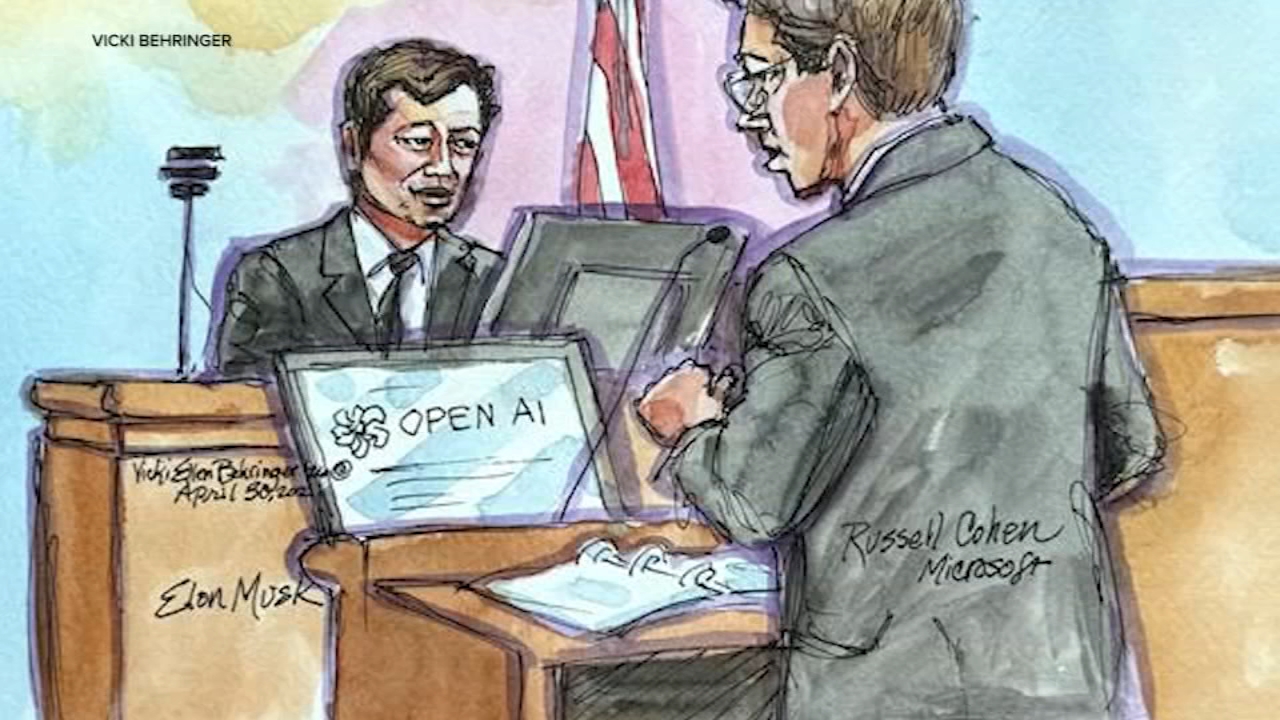
Elon Musk's lawyer began his cross examination of OpenAI CEO Sam Altman in court on Tuesday with a brief question: "Are you completely trustworthy?"

Musk is suing the company and its leaders over allegations that OpenAI, Altman and president Greg Brockman breached their charitable trust when OpenAI shifted from its nonprofit mission to include a profit-oriented structure. Microsoft, an early investor in OpenAI, is named as a co-defendant.

Musk's lawyer grilled Altman about accusations of dishonesty from OpenAI's board members, his investments and his brief, tumultuous ousting as CEO in 2023.

In contrast, OpenAI's attorney suggested Musk, who helped create and fund the company, angled early for total control of OpenAI as Altman pushed back to ensure the powerful tech was not dominated by just one person.

Musk wants the judge to order OpenAI to revert to a nonprofit and for Altman and Brockman to lose their board positions. He's also asking that more than $130 billion go back into OpenAI's nonprofit arm. A ruling in Musk's favor could scramble OpenAI's plans for an initial public offering later this year.

OpenAI has denied Musk's claims, saying Musk wanted a for-profit structure and only brought the case after he failed to gain control of OpenAI. OpenAI has claimed Musk, who started his own AI company after leaving OpenAI in 2018, is now attempting to harm a competitor.

Altman's trustworthiness questioned

Musk attorney Steven Molo cited earlier testimony from OpenAI board members and former executives that Altman was dishonest and created a toxic culture of lying.

Altman called himself "an honest and trustworthy business person" but said he wasn't aware of some specific accusations.

Altman also criticized how the board handled his removal and said there were "misunderstandings."

"I was not trying to deceive the board," he said.

OpenAI board members and executives testified about their qualms with Altman earlier in the trial, including what they described as his resistance to the board's oversight and alleged dishonesty with senior leadership, including former Chief Technology Officer Mira Murati.

OpenAI cofounder Ilya Sutskever, who played a major role in Altman's displacement, testified on Monday that he spent months gathering evidence showing what he said was Altman's pattern of deception and poor management. Sutskever later voted to have Altman return, saying he regretted the decision. Altman returned to his role just days after his removal and a new board was instated.

Altman described the 2023 events as an "incredible betrayal" that was "very public" and "very painful" in Tuesday's testimony.

"If I knew how difficult and painful this was going to be, I never would have tried," Altman said of his decade at OpenAI. "I'm very grateful I didn't, because other than my family, this has been the most meaningful thing in my life I could imagine."

Control over the future of AI

Control over artificial general intelligence, a hypothetical stage of AI in which its cognitive abilities match that of a human across any subject, was an important factor in OpenAI's founding, Altman said. The company was founded in part because Altman and the other cofounders believed one person should not be in charge of AGI if it were achieved, he said.

Musk wanted "total control" of any for-profit OpenAI entity to start, Altman testified, with a promise to reduce that control over time. But Altman wasn't convinced Musk would step back, citing his experience working with startups where leaders rarely give up power over a successful company, he said.

"My belief is he wanted to have long-term control and that he would have had that had we agreed to the structure he wanted," Altman said.

OpenAI's cofounders once asked Musk an important question: If he were to control OpenAI, what would happen to the company on his death? Musk responded that he hadn't thought about it much and that he might pass it on to his children.

Musk's reply was a "hair-raising moment" in the early days of OpenAI, Altman said.

"I didn't feel comfortable with that," Altman said

Musk eventually resigned because he lost confidence in OpenAI and didn't think it would be successful, Altman suggested. At one point, Musk wrote in an email that OpenAI wasn't a "serious counterweight" to Google's DeepMind AI research lab, according to evidence presented in court.

Google was considered the AI leader around the time OpenAI was established. Altman almost didn't even start OpenAI because he thought the search giant was so far ahead, he said.

Before resigning from OpenAI's board in 2018, Musk "demotivated" some key researchers by ranking their accomplishments, Altman testified, which damaged the company culture. Musk's resignation boosted morale, Altman added.

This story has been updated with additional information.

The-CNN-Wire
& 2026 Cable News Network, Inc., a Warner Bros. Discovery Company. All rights reserved.