Musk v. Altman live updates: Tesla CEO spars with OpenAI attorney over company's evolution

ByABC7 Bay Area Digital Staff and Frances Wang KGO logo
Last updated: Friday, May 1, 2026 4:12AM GMT
Musk spars with OpenAI attorney over company's evolution

OAKLAND, Calif. (KGO) -- Technology tycoons Elon Musk and Sam Altman are poised to face off in a high-stakes trial revolving around the alleged betrayal, deceit and unbridled ambition that blurred the bickering billionaires' once-shared vision for the development of artificial intelligence.

The trial, which is scheduled to begin Monday with jury selection, centers on the 2015 birth of ChatGPT maker OpenAI as a nonprofit startup primarily funded by Musk before evolving into a capitalistic venture now valued at $852 billion.

The civil lawsuit accuses Altman, OpenAI's CEO, of double-crossing Musk by straying from the company's founding mission to be an altruistic steward of the technology.

AP logo
May 01, 2026, 4:12 AM GMT

Elon Musk spars with OpenAI attorney over company's evolution from a nonprofit

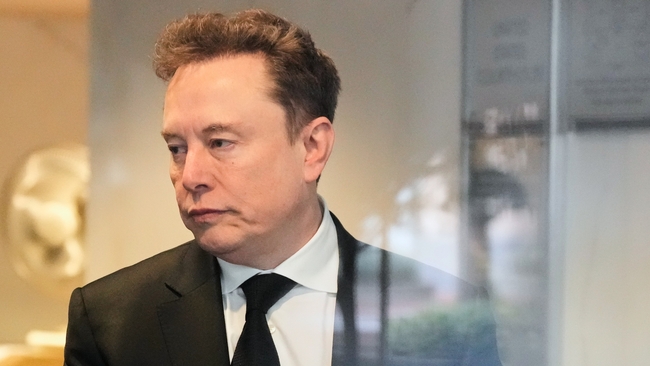
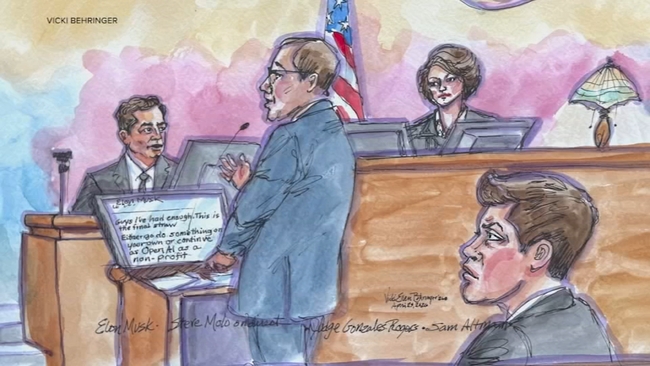
Elon Musk on Thursday sparred with an attorney for OpenAI during his third day of testimony in the contentious trial over the company's pivot from nonprofit status to a for-profit venture valued at hundreds of billions of dollars.

The trial centers on the 2015 birth of the ChatGPT maker as a nonprofit startup primarily funded by Musk. It pits the world's richest person against Sam Altman, a fellow OpenAI co-founder he accuses of betraying promises to keep the company as a nonprofit dedicated to humanity's benefit.

Tempers have flared on both sides of the high-stakes trial, as the morning began with an existential discussion about the future of humanity - complete with references to "The Terminator" movies - and how much witness testimony would focus on AI safety.

"Your client, despite these risks, is creating a company that is in the exact same space," Judge Yvonne Gonzalez Rogers told Musk's lawyers, referring to the billionaire's xAI, which launched in 2023. People, she said, "don't want to put the future of humanity into Mr. Musk's hands," and instructed the parties not to discuss the dangers of AI to humanity during the course of the trial.

"This is not a trial on the safety risks of artificial intelligence. This is not a trial on whether or not AI has damaged humanity," she said. "It could be one day in a federal court in this country that we may have that trial. That is not this trial and we are not going to get sidetracked on that issue in this trial."

On the stand, Musk has taken issue with the cross-examination by opposing attorney William Savitt, accusing him of asking misleading questions designed to trick him and the jury. At one point Thursday, Savitt asked Musk about earlier testimony where he said that as long as investor profits were capped, OpenAI wasn't in violation of agreements to keep it a nonprofit.

"It depends on how high the cap is," Musk replied. Savitt then said that "wasn't your complete answer yesterday right?" In response, Musk said "few answers are going to be complete, especially if you cut me off all the time." He added that if the cap is "super high," then OpenAI is "really a for-profit at that point."

Lawyers for OpenAI have rejected the allegations brought in Musk's civil lawsuit and said there were never promises that the company would remain a nonprofit forever. The company has argued Musk's legal challenge is aimed at undercutting OpenAI's rapid growth and bolstering Musk's xAI, which he launched in 2023 as a competitor.

The trial in federal court in Oakland, California, is scheduled to continue through late May. Judge Yvonne Gonzalez Rogers excused Musk from the witness stand Thursday, but he may be called back later.

During the cross-examination, Savitt also asked Musk about his companies - Tesla, SpaceX, Neuralink and X - and whether they were all for-profit. Musk replied yes, and affirmed that he believes all of these companies are "socially beneficial."

Savitt then asked why Musk hasn't started a nonprofit himself, eight years after he left OpenAI.

"I thought I had started a nonprofit with OpenAI but they stole it," Musk replied, adding that this is "the entire basis of this lawsuit."
ByFrances Wang KGO logo
Apr 30, 2026, 2:52 AM GMT

Elon Musk clashes with defense attorney during cross-examination in trial over OpenAI's origins

Elon Musk clashed with a defense attorney Wednesday during cross-examination in his federal trial over OpenAI's origins, with repeated courtroom tension, judicial intervention and disputes over early company emails and structure.

Elon Musk clashed with a defense attorney Wednesday during cross-examination in his federal trial over OpenAI's origins, with repeated courtroom tension, judicial intervention and disputes over early company emails and structure.

Musk, who was being questioned for a second day on the witness stand, pushed back against questions from defense attorney William Savitt, arguing at times that they were misleading.

At one point, Musk told Savitt his questions were "not a simple yes or no" and were "designed to trick me," prompting continued back-and-forth between the two. He also said some of the e-mails and messages he was asked about in court were difficult to recall as they were many years ago.

The exchanges escalated enough for Judge Yvonne Gonzalez Rogers to intervene several times, instructing both sides to stop speaking over one another so the jurors could hear what they were saying and also so the court reporter could transcribe.

Savitt, who previously represented Twitter in its legal battle with Musk over his $44 billion takeover of the company, is now part of the defense team representing OpenAI.

The case centers on Musk's claim that OpenAI deviated from its founding mission as a nonprofit created to benefit humanity. Musk helped found the company in 2015 and invested roughly $38 million.

He alleges the organization shifted away from its original charitable purpose as it moved toward a more commercial structure. Musk has argued the company should have remained under nonprofit control and has accused OpenAI leadership of straying from its founding commitments.

Defense attorneys, however, have pointed to emails, text messages and deposition testimony they say show Musk was aware of and at times supported discussions about alternative corporate structures, including arrangements involving for-profit entities supporting nonprofit work.

In court, Savitt presented several pieces of evidence he argued showed Musk's early proposals envisioned him holding significant control.

Musk argued that control would have decreased as the company brought in additional investors and board members

The defense has argued the dispute is ultimately about control and competition in the artificial intelligence industry, alleging Musk became critical of OpenAI only after losing influence and later launching his own AI company, xAI. Savitt questioned Musk on his reasonings for cutting off quarterly funding in 2017, wondering if it was to force "financial pressure" on a company he felt he couldn't gain
control of.

Savitt said the evidence "is not as how Mr. Musk has described them," referencing what he characterized as a broader documentary record of early discussions and agreements.

Musk has maintained he was never opposed to a for-profit structure so long as profits are capped and the organization continues to serve its original nonprofit mission. He has also accused OpenAI leadership of abandoning that mission and has described himself as having been misled.

The defense, meanwhile, has portrayed Musk as a founder who became dissatisfied after failing to secure control and later withdrew financial support as tensions escalated.

Musk is expected to return to the stand Wednesday to complete cross-examination. Two additional witnesses are expected to follow and then next up: defendant and OpenAI Greg Brockman.

CNNWire logo
Apr 29, 2026, 4:59 PM GMT

Musk testifies for 2nd day: 'I was foolish enough to believe him'

Elon Musk took the stand for a second day of testimony against OpenAI and its leaders in a lawsuit that could reshape the future of artificial intelligence, as the emerging technology has sent ripples through the economy and financial markets.

Musk claims OpenAI betrayed its initial nonprofit mission when it changed its corporate structure; OpenAI, for its part, claims Musk's suit is meant to derail its position as a competitor to his own artificial intelligence company, xAI.

In court, email exchanges between Musk and Altman were shown.

On one e-mail exchange between the two about the non-profit structure, Musk reflects: "I was foolish enough to believe him.'

Musk said he received reassurances that OpenAI would remain non-profit and continued to donate over what he estimates was $10 million.

ByFrances Wang KGO logo
Apr 29, 2026, 2:20 AM GMT

Musk testifies on how he sees AI evolving

Musk said he expects AI to be "smarter than any human" as soon as next year. Musk said a longstanding concern about AI is the question of what happens when computers become much smarter than humans.

Musk was called as the first witness shortly after noon, following opening statements from attorneys for OpenAI and Microsoft. When questioned by his own legal team, Musk said the defendants were trying to complicate this case.

He told jurors that, in his view, the case could set a precedent that risks losing every charity in America, adding that the consequences "go far beyond me."

Once sworn in, Musk spent much of the first part of his testimony walking jurors through his personal background. He described moving to North America because he wanted to be part of the technology industry, and recalled early jobs as a lumberjack and restaurant server before his first business ventures.

Musk then outlined the origins of companies he later founded or led, including PayPal, SpaceX and Tesla. He said SpaceX was created to make life multiplanetary and preserve human consciousness, while Tesla grew out of his belief that electric vehicles were essential for the future. He also briefly discussed Neurolink and The Boring Company, telling jurors he works 80 to 100 hours a week and does not take vacations.

"No vacation homes, no yachts or anything," Musk said.

About 30 minutes into his testimony, Musk turned to artificial intelligence. He explained artificial general intelligence, or AGI, as a point where AI becomes as smart or smarter than any human.

"I think we are getting close to that point," Musk said, adding, "My guess is AI will probably be smarter than any human... next year."

Jurors appeared closely focused as he spoke.

Musk compared developing AI to raising a child, something you cannot fully control, he said, but can try to guide with values. He described himself as "extremely concerned" about AI and said he has been for a long time.

He also recounted a past disagreement with Google cofounder Larry Page, saying Page once called him a "speciest" for prioritizing human survival. Musk told jurors he found Page's stance "insane."

Musk said he also tried to warn former President Obama about the risks of AI, but at the time, "AI was not good enough to seem scary smart." He added, "Here we are in 2026, AI is very smart."

Later in his testimony, Musk described his early interactions with Altman, saying the two attended meetings and dinners during the early days of AI discussions. Altman was not in the courtroom during the entirety of Musk's testimony, though cofounder Greg Brockman remained.

The trial continues this week, with additional witnesses expected to testify as both sides lay out sharply different accounts of OpenAI's origins and mission.