2026 MLB trade deadline grades: Report cards for every deal

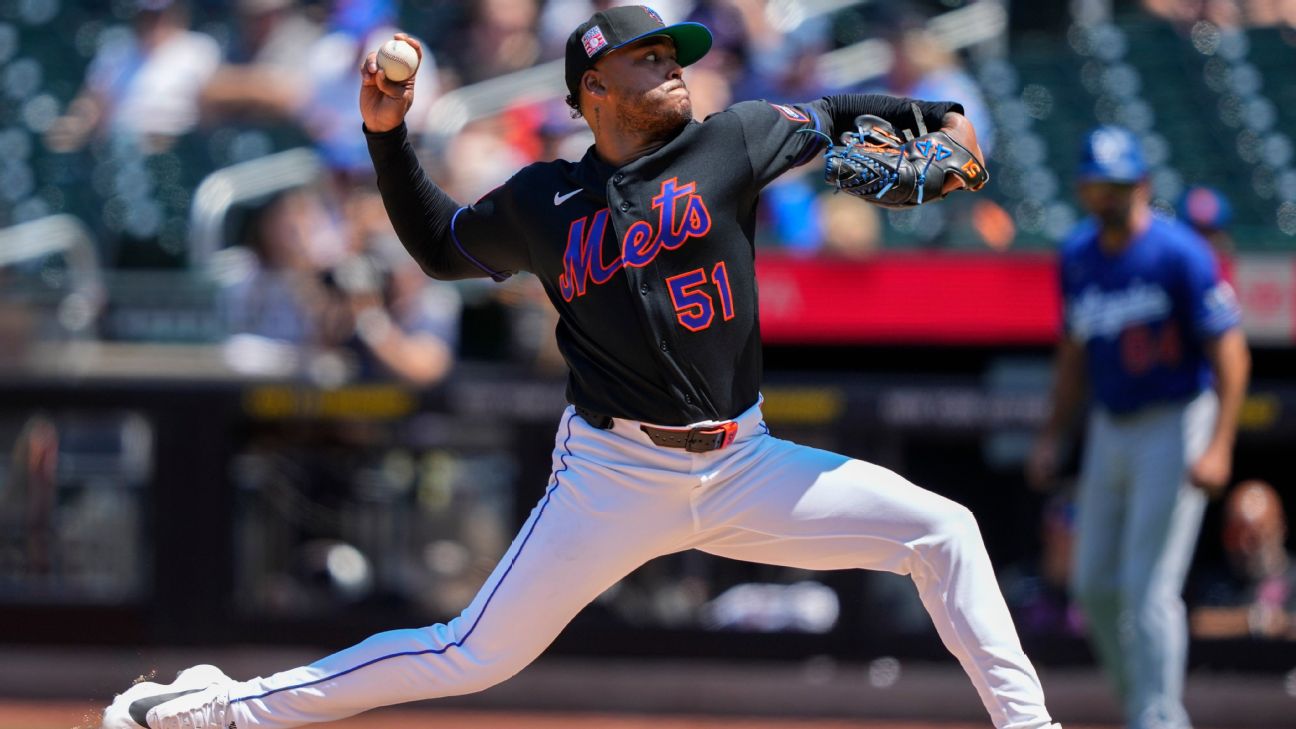
From the early deals that got things rolling to the last-minute flurry of trade deadline day activity, this is your one-stop shop for grades and analysis breaking down this year's biggest trades.
ESPN MLB experts Bradford Doolittle and David Schoenfield evaluate and grade the most significant moves below.
Giants trade Mahle to Braves

Atlanta Braves get:
RHP Tyler Mahle

San Francisco Giants get:
RHP Anthony Molina
Braves grade: C+
The Braves really didn't give up anyone in this deal, tossing in Molina because the Giants are going to need somebody to throw baseballs from the mound after whatever they do before the deadline. In effect, Atlanta is taking on remainder of Mahle's expiring deal as the Giants seemingly look to make their payroll as lean as possible.
Mahle, 31, is in his 10th big league season by the calendar, but he has been so bedeviled by injuries that he has averaged about only 16 starts per season. He's already at 18 this season but his 77 ERA+ is his worst yet. Knowing Alex Anthopoulos, Braves GM and president of baseball operations, Mahle will not be the only No. 4 and 5 starter targeted by Atlanta -- Anthopoulos likes to have options. The Braves often find success with pitchers like Mahle -- see Martin Perez -- so it's worth watching what, if anything, changes when he arrives in Atlanta.
We're at the point of the schedule when the healthy version of the Atlanta rotation we thought we'd might see isn't likely to come together. The problem worsened this weekend when Reynaldo Lopez hit the IL because of a sore knee. The Braves could really use a big-time No. 2 to slot behind Chris Sale, but those options are dwindling. Still out there are solid possibilities like Casey Mize and Jose Soriano but in the meantime, Anthopoulos is making sure he has enough depth to get through the season.
Mahle helps the regular-season part of that plan, at least. As for the playoff part of the agenda -- well, there's still some time until the deadline.
Giants grade: C-
The Giants weren't likely to get much of a prospect for Mahle, but they could have gotten more on the upside front, some 18-year-old with arm talent. Molina, 24, is a fringe big leaguer with good fastball velocity and no proven record of missing bats as a big leaguer. So it's hard to not see this move as a pure salary dump. Maybe the Giants think they can help Molina turn the corner? You never know where a quality reliever will come from.
Cubs bolster rotation, get Gausman from Jays

Chicago Cubs get:
RHP Kevin Gausman

Toronto Blue Jays get:
OF Brett Bateman
INF Ty Southisene
Cubs grade: B
The Cubs are rumored to be chasing any kind of pitching help. While that might suggest a quantity over quality approach, they'll be in great shape if they can keep bringing in hurlers as accomplished as Gausman.
Gausman is as steady as they come, a good bet to reach 31-33 starts and 180 or more innings with an ERA+ about 10% better than the league. He's not on the same plateau he was a few years ago, when he contended for a Cy Young Award, but he has been basically the same pitcher the past three years, albeit one who has suffered from a BABIP spike in 2026. Good news for that BABIP: Gausman will now have baseball's best team defense behind him.
Gausman offers innings stability to a pitching staff that has been rocked by the injury bug but nevertheless has a nifty playoff rotation shaping up if their luck changes. Gausman, Matthew Boyd, Shota Imanaga and Edward Cabrera are a formidable quartet -- and the Cubs might not be done adding.
Is it as sexy as landing Tarik Skubal? It is not. But it's an upgrade to a club that can reasonably hope to be playing past the first week of October. If that happens, Gausman would be in the postseason with his fifth different club and looking to get back to the World Series after helping Toronto get there a season ago.
Blue Jays grade: C+
Given Gausman's status as a 35-year-old hurler on an expiring deal, and his midrotation level of performance this season, the Blue Jays did well to land a pair of non-elite hitting prospects who have a real chance to eventually help them at the big league level.
In fact, MLB Trade Values has this deal as a clear win for the Blue Jays, based on its model for figuring surplus value, but that judgment is predicated on how you evaluate Bateman and Southisene. Across the different prospect outlets, there's no clear consensus on how the two should be rated. Southisene is generally in the 10-20 range among Cubs prospects, while Bateman is 10-15 spots lower.
Less important than the rankings are the traits this pair possesses at the plate. While Southisene is an undersized, righty-hitting infielder and Bateman a lefty-hitting center fielder, they share some commonalities on the strengths and weaknesses ledger when it comes to offense. Both are disciplined, high-contact swingers with some speed. Both hit the ball on the ground and have little to no power. As such, they are both projects and unlikely regulars.
But you never know. The Blue Jays have built their big league offense around contact-first hitters while coaxing more bat speed and power out of them, so Southisene and Bateman might simply fit the profile of the kind of hitter Toronto thinks it can develop. This is the how these kinds of trades are supposed to work for teams turning the page toward next season.-- Doolittle
Yankees nab slugging infielder Garcia from Nats

New York Yankees get:
1B/2BLuis Garcia Jr.

Washington Nationals get:
RHP Yovanny Cruz
RHP Jake Bird
RHP Ben Grable
RHP Jack Cebert
Yankees grade:B+
How many baseball fans would know that Garcia entered Sunday leading the National League with a .560 slugging percentage? Not many. Garcia's transformation as a player has been wild, entering the league in 2020 as a light-hitting middle infielder and now morphing into a power-hitting first baseman. With Aaron Judge and Cody Bellinger both on the injured list, the Yankees were desperate to add offense after ranking 26th in the majors in OPS in July (although still posting a winning record at 14-11). As has been Brian Cashman's approach in recent trade deadlines, the Yankees acquired a player in Garcia who is under team control through 2027.
One thing that hasn't changed about Garcia is he rarely walks, so though he's hitting .283, his on-base percentage is a mediocre .313. The power surge in 2026 has kind of arrived out of nowhere, as he had five home runs through May before blasting 18 across June and July. As a left-handed batter who pulls the ball a lot -- 21 of his 23 home runs have gone to right field or right-center, his power will certainly play at Yankee Stadium. Is Garcia's power for real? The metrics say he has been pretty legit, with Statcast expected numbers of a .290 average and .511 slugging. Maybe a little over his head, but he's definitely learned to launch the ball more in the air with a hard-hit rate in the 78th percentile.
The one issue here: Where will he play? The Nationals booted him off second base because of his poor range there and he has played only first base in 2026. The Yankees have Ben Rice and Paul Goldschmidt at first base and DH, plus Giancarlo Stanton will eat into DH at-bats if or when he returns. That probably leaves second base for Garcia, with Jazz Chisholm Jr. moving to third base or the outfield, both positions he has played. No matter what happens, it's a defensive downgrade somewhere for the Yankees, so while Garcia is obviously a nice pickup, it's hard to give this an "A" grade, even though the Yankees didn't give up one of their top 10 prospects.
Nationals grade:C-
The Nationals' losing streak reached five games Sunday, essentially moving from playoff pretenders to noncontenders. After making a widely praised trade in sending Curtis Mead to the Red Sox for Connelly Early, the Nationals understandably went out for more pitching help and cashed in on Garcia's career season, but it's hard to know if Paul Toboni hit a similar home run here.
Maybe he did. Cruz has reached the majors and throws 100 mph. He's also 26 with an injury history and, until this season, an inability to throw the ball across the plate often enough. Grable is another reliever, an 11th-round pick last year out of Indiana as a fifth-year senior who has had a big breakout in the minors with an upper 90s fastball that has huge induced vertical break, leading to 56 strikeouts in 36 innings. He also sat out two seasons in college because of elbow injuries, including Tommy John surgery. Cebert is actually the highest-ranked prospect in the group, a starter who has reached Double-A. Bird, you probably know about: journeyman reliever with a 5.93 ERA with the Yankees.
The Nationals certainly need to remake their bullpen, so maybe this helps, but while they lead the majors in runs, that's because Mead and Garcia were providing big production at the infield corners. Brady House andAndres Chaparrowill get a run at those positions the rest of the way, but the Nationals might heading into the offseason looking for ... offense.-- Schoenfield
Rays add Peralta to rotation

Tampa Bay Rays get:
RHP Freddy Peralta

New York Mets get:
2B Emilien Pitre
RHP Gary Gill Hill
OF Aidan Smith
Rays grade: B-
The Tampa Bay rotation has been effective, ranking fifth in the majors in ERA, but there were some obvious concerns as to why it needed another starter:
- Shane McClanahan is on the injured list because of back tightness, although he's expected to miss only a couple of starts (and this could've been an excuse to back off on his innings, since he had sat out the past two full seasons).
- The rotation ranks 22nd in innings, with reliever-turned-starter Griffin Jax already at a career high in innings pitched.
- They've already been using Casey Legumina as an opener for Ian Seymour the past couple of turns through the rotation.
So even if Peralta is just a fourth or fifth starter in this rotation, the Rays needed someone who could deliver some innings and help relieve some of the stress on the bullpen while providing insurance to the workloads of McClanahan and Jax. Of course, Peralta hasn't been very good with the Mets, going 5-9 with a 4.99 ERA. But he's also one season removed from winning 17 games with a 2.70 ERA for the Milwaukee Brewers in 2025.
Though that was a career year, maybe the Rays can help him rediscover the feel for his changeup. Batters hit .173 against it last year but are hitting .280 against it in 2026. As a result, Peralta has struggled against left-handed batters, giving up 13 home runs and an .811 OPS. There's no guarantee he'll pitch better, although the Rays have a good track record of improving or fixing pitchers. Just check out three-fifths of their rotation, as Jax and Drew Rasmussen were relievers before coming to the Rays, while Nick Martinez turned into an All-Star this year for the first time after signing with Tampa Bay.
Mets grade: C+
Bottom line: The market for short-term acquisitions doesn't usually provide big dividends these days, and Peralta's ERA didn't help. None of the prospects the Mets got were in Kiley McDaniel's midseason top 10 for the Rays, although Gill Hill and Smith have been top-10 prospects in the past.
Pitre now appears to be the most promising of the three, a 23-year-old from Quebec whom the Rays drafted in the second round in 2024 out of the University of Kentucky. He's hitting .308/.438/.447 with five home runs and 32 stolen bases in the minors, including .323/.451/.492 in 37 games after a promotion to Double-A. The left-handed batter has one stat that especially stands out: a 70-40 strikeout-walk ratio, suggesting a great eye to go with excellent contact skills. That's an old-timey type of ratio. We'll see if it translates to major league production given the lack of power. Gill Hill has seen his strikeout rates decline as he has climbed to higher levels, and Smith, after a strong season in Single-A in 2024, is struggling at the plate in his second year in High-A. -- Schoenfield
Dodgers win sweepstakes for Skubal

Los Angeles Dodgers get:
LHP Tarik Skubal

Detroit Tigers get:
OF Zyhir Hope
RHP River Ryan
RHP Brady Smith
Dodgers grade: A
Let's consider this from the Dodgers' overall big league level of talent, measuring the period from 2023 to the present. The Dodgers have the hitters ranked Nos. 2, 7, 15, 25, 30 and 33 by wins above average, per Baseball Reference. (That's Shohei Ohtani, Mookie Betts, Freddie Freeman, Kyle Tucker, Max Muncy and Will Smith.) They have the relievers ranked Nos. 14, 28, 32 and 38 by ERA+. (Tanner Scott, Evan Phillips, Alex Vesia and Edwin Diaz.) Their rotation, also by ERA+, has Nos. 2, 4, 5, 7 and 24. (Skubal, Ohtani, Blake Snell, Yoshinobu Yamamoto and Tyler Glasnow.) It is very much an All-Star roster -- stuffed with potential Hall of Famers who are all producing at a high level.
It's amazing, it's an abomination, and it has become a rallying cry for the owners in the CBA talks. And it's very bad news for anyone hoping to topple the Dodgers this October and prevent what now feels increasingly like an inevitable three-peat.
Skubal is the best pitcher in the sport, going to the best team in the sport, and the worst of it for non-Dodger fans is that the team you were hoping would land Skubal did not get him.
For Bradford Doolittle's full grade on the deal, read here.
White Sox land Castillo in deal with M's

Chicago White Soxget:
RHP Luis Castillo

Seattle Mariners get:
RHP Seranthony Dominguez
OF Nolan Jones
C/LF Boston Smith
White Sox grade: C+
Castillo is a big-name acquisition for a White Sox rotation that has been rolling out struggling rookie Noah Schultz (6.15) and veteran Erick Fedde (4.13 ERA but a 5.34 FIP) as its back-end starters, so even a clearly declining Castillo with a 5.06 ERA looks like at least a minor upgrade.
The good news for the White Sox: They acquired someone who might help this season as they make a playoff push -- ahead of schedule -- without sacrificing any of their top prospects. All they had to give up were some nonessential players on their roster and their No. 15 overall prospect, according to MLB.com. Oh ... and take on the rest of Castillo's $24.15 million salary this season and the $24.15 million next season. That financial burden will be felt for a pitcher with an ERA on the wrong side of 5.00, but the White Sox, with so many minimum-salaried players, can afford to take on Castillo.
The question is how much Castillo has to offer. His strikeout rate has dropped from 29% during his first season in Seattle in 2022 to a career-low 19.4% this season. He no longer has a big swing-and-miss offering, and he has lost feel for his once-lethal changeup to the point where it's now his fourth offering, behind his fastball, slider and sinker. Without an effective changeup, left-handed batters have slugged .537 with an .890 OPS off him. Yes, he'll fill out the rotation for the rest of the season, but this isn't a pitcher you want to start in a playoff game.
Mariners grade: B
This is ... fine. With a six-man rotation and Kade Anderson in the minors, the Mariners didn't need Castillo. He has clearly lost effectiveness this season, even with a fastball that still averages 95.3 mph. The big win for the Mariners is trading the money Castillo will make next year. They don't need him, and that clears some money to spend elsewhere (well, presumably, you never know).
And Smith is an intriguing prospect, hitting .291/.448/.589 with 22 home runs in the minors, most of that in High-A before a promotion to Double-A. He's hitting even better there, with a 1.146 OPS and eight home runs in 22 games. He has power, draws walks and strikes out a lot as he works deep counts, looking for pitches he can drive. He might not be a catcher in the long run, but he runs well enough that he has played a little bit in the outfield and he's athletic enough that he played some shortstop at Wright State.
Does this trade help the Mariners in 2026 as they desperately try to avoid plummeting out of the playoff race? No, because Dominguez is a mop-up-caliber reliever, and Jones has spent the season in the minors, with those two included in the trade primarily for payroll purposes. But between the payroll relief for 2027 and Smith's under-the-radar potential, it's a good deal for the Mariners.-- Schoenfield
Braves bring in Thomas, Falter from Royals
Atlanta Braves get:
OF Lane Thomas
LHP Bailey Falter

Kansas City Royals get:
RHPLucas Braun
LHP Carter Holton
Braves grade C-
At some point late in the Braves' lost 2025 season, lead exec Alex Anthopoulos started to acquire just about every veteran with a recognizable name who popped up on the DFA/waiver market. The reason was never clear, though nothing was lost in the frenzy and all information you are able to glean on a player is useful information. None of those acquisitions moved the needle forward, including the pickup ofHa-Seong Kim, who, for a time, seemed slated to be Atlanta's every-day shortstop this season.
Though that strategy seemed intriguing as a response to a bad campaign, the fact that this move feels like one of those is less enthralling. After all, the Braves are in first place and in a spot to bolster their roster for the stretch run and the playoffs. Thomas fills a need for a right-handed-hitting outfielder who could work as a platoon partner withMike Yastrzemski. But Thomas is limited, and it feels like even in a market light on righty hitters, Atlanta might have done better with a more well-rounded performer. And maybe the Braves will -- Anthopoulos often takes a crowdsourcing kind of approach to filling roster holes.
Falter has been unplayable as a big leaguer since Kansas City added him last year in a trade with Pittsburgh. He has been decent in a swing role for Triple-A Omaha and has a lot of big league experience, though not much of it has been paired with above-average production.
This deal might make more sense when we have the full context of Atlanta's deadline approach. For now, it's uninspiring.
Royals grade: B-
Virtually nothing has gone right for the Royals this season. That's certainly true for everything that has happened during the regular season, but it applies to their offseason as well. The Royals entered the hot stove part of the calendar with a clear need for an outfield upgrade and they ended up with Thomas, whose slash line over the past three seasons is .224/.305/.380. He's better against lefties -- hence the Braves' interest -- but the Royals needed more of a full-service contributor.
This deal is a solid pivot now that the white flag has been unfurled. The Royals aren't really dealing from a position of strength, but in Braun and Holton, they have added a couple of solid pitching prospects for two players they did not need to retain. Braun, 24, is a command-over-stuff righty who fits the general mold of the kind of starter (Michael Wacha, Seth Lugo)who has worked well for Kansas City. He has been pitching well for Gwinnett and should help the Royals sooner than later, if not immediately.
Holton is a lefty with some injury baggage, but he was a second-round pick out of Vanderbilt just a couple of years ago. His development is well behind schedule because of the injuries, but the baseline talent is there. He'll add depth to a Royals system that needs more at the upper levels.-- Doolittle
Pirates get hard-throwing Doval from Yankees

Pittsburgh Pirates get:
RHP Camilo Doval
New York Yankees get:
C Omar Alfonso
OF Luis Cruz
Pirates grade: C-
The Pirates recently parted ways with occasional closer Dennis Santana and apparently missed the kind of high drama his appearances tended to produce. Doval has been, if nothing else, a human tightrope. His stuff is hard and heavy at elite levels, headlined by a 98 mph sinker that produces loads of ground balls if he manages to get it near enough to the strike zone to induce a swing.
His problem is mind-numbingly poor command that leads to both a scourge of free passes and meatballs that end up on the wrong side of the fence. But Doval does have success on his résumé. He led the NL in saves during an All-Star campaign in 2023 and, when he joined the Yankees, it was an open question as to whether he or Bednar, also acquired at last season's deadline, might seize the ninth-inning role.
Pittsburgh has had success with righting the ship of veteran relievers -- Santana had been one of them -- so maybe they can get Doval back on track. But for a club with little margin for error, Doval is maybe a bit too erratic to provide the immediate boost the Pittsburgh bullpen needs.
Yankees grade: B
For the Yankees' big league roster, this is a matter of addition by subtraction, because as good as Doval has been at times during his career, he just wasn't getting it done in pinstripes. For his 66 games in New York, he finishes with two saves, a 4.63 ERA and minus-1.1 bWAR. Presumably, New York will now seek better high-leverage options to support the back of its David Bednar-led bullpen.
In offloading Doval, the Yanks pick up a legit catching prospect in Alfonzo, a 22-year-old who is part of a family of backstops that includes his father and brother. He is ranked in the top 30 at both Baseball America and MLB Pipeline with grades that paint the picture of a solid defender with a good arm, decent offensive potential with average power and painfully little foot speed. A lefty hitter, he could potentially hold down the heavy side of a catching platoon if he continues to progress. Alfonzo is not a right-now solution for the Yankees' catching woes, however.
Cruz, 18, is raw in body and experience. An outfielder, he's listed at 6-foot-2, 155 pounds and is in his second season in the Dominican Summer League after signing with the Pirates in January 2025. His numbers suggest a young hitter with good bat-on-ball skills, for what the numbers are worth at that level. He has yet to homer as a professional. He is one of many wild-card prospects we'll see moved around the deadline. -- Doolittle
Brewers and Guardians make two-for-two swap

Milwaukee Brewers get:
C Bo Naylor
RHP Codi Heuer

Cleveland Guardians get:
RHP Craig Yoho
OF Blake Perkins
Brewers grade: C
A "C" grade in trade evaluation isn't any different than one earned in a classroom. It denotes a perfectly acceptable, average performance. There isn't much surplus value being exchanged here and so there is little reason to nudge the rating for either club too far away from the "C" baseline.
Naylor was a touted catching prospect, expected to possibly outshine brother Josh once he hit the majors. But he has never hit, and while he remained in Cleveland after his brother moved on, the Guardians are now out of the Naylor business altogether. His defensive numbers have jumped all over the place in the bigs, but he is more or less what his scouting reports previewed -- an above-average receiver who could stand to do a better job of controlling the running game. His offense has been a cipher.
Heuer is a journeyman righty who, like every player in this deal, has been up and down from the minors this season. Both he and Naylor were immediately assigned to Triple A Nashville by the Brewers when the deal was announced. He lacks a standout weapon like Yoho's changeup, but he does possess above-average velocity and elite extension. That intrigues you because the Brewers are apt to work magic with veteran bullpen acquisitions. To wit: Earlier this season, they plucked Joel Kuhnel from the Athletics, and while he didn't turn into Rollie Fingers with Milwaukee, he did suddenly add 3-4 mph to his fastball as if the Brewers flipped an invisible switch.
This trade may be just about creating roster space for players returning from injury. Perkins has been a solid role player but Milwaukee has a glut of outfielders. The Brewers could use more depth at catcher. At the same time, there could be something else brewing here, pun intended. One of Milwaukee top prospects, Jeferson Quero, is a catcher in Triple A and would be a fine component of any kind of splash trade for a frontline pitcher. Stay tuned.
Guardians grade: C+
The Guardians stubbornly prize elite defense behind the plate even with any concerns about hitting and while Naylor has the tools to be an above-average defensive catcher, he wasn't in the class of Patrick Bailey or Austin Hedges. With utility-guy-who-can-catch David Fry around and Cleveland trying to find a role for prospect Cooper Ingle, moving Naylor makes sense. Heuer wasn't doing much to help their big league bullpen and in Yoho, they add a solid role player whose off-speed stuff can complement Cleveland's deep relief staff.
Perkins can run the bases, defend and is a switch-hitter whose offensive production is lacking. In other words, he's a consummate Guardians position player. The plus on Cleveland's grade is for Yoho's fit, but for the Guardians, this feels like a low-level deal meant to squeeze a little more utility out of the 40-man roster spots beyond those 26 who are currently active. -- Doolittle
Twins acquire starter Kremer from Orioles

Minnesota Twins get:
RHP Dean Kremer

Baltimore Orioles get:
OF Jhomnardo Reyes
Twins grade: C-
The Twins are off to an aggressive start during the deadline period, adding Kremer to their rotation one night after picking up lefty A.J. Minter to bolster their bullpen in exchange for two infield prospects. Minnesota's system has lost three prospects -- and Reyes was the highest-rated of the three.
Kremer is under team control beyond the rest of the season, which is probably why he merited the better return. (That controllable season is the last of his arbitration-eligible campaigns, so who knows what that might mean under the next CBA.) Assuming the status quo regarding arbitration, Minnesota would have some stability for the back of its rotation. Kremer is on the books for $5.75 million this season and, barring a strong finish, won't have a case for a big raise this winter.
The reluctant grade is a result of Kremer's season, which has not been at a level that would aid the Twins' playoff push. In seven starts, he's 1-4 with a 6.50 ERA and 6.24 FIP, the latter a result of his alarming rate of three homers allowed per nine innings. Kremer is better than that, but he has been a persistently just-below-average producer for his career.
Perhaps the Twins see something in Kremer they think they can work with, and, to be sure, the bar for upgrading the bottom of their rotation is pretty low. I'm willing to write off a certain amount of value disparity in a deal if the team in add-mode has boosted its short-term probabilities enough. I'm just not sure the Twins have done that.
Orioles grade: B+
The Orioles have seen plenty of Kremer, and though some might see this move as the start of a deadline subtraction, that remains to be seen. Kremer hasn't been very good. If the Orioles, a team that had a 16% shot at the playoffs in my odds at the beginning of the day, want to hang in, they expect to get Chris Bassitt back soon to fill out the rotation. Or maybe they'll trade him too.
Either way, the chance to pick up a really quality prospect in Reyes, 18, for a pitcher who wasn't helping was too good to pass up. Baseball America had Reyes ranked 12th in a very good Minnesota system, and MLB Pipeline had him 24th. He's a lanky corner outfielder with plus power and a big arm, and though he's a high-risk/high-reward kind of prospect, his raw ability is worth the gamble.
We don't know Baltimore's deadline approach just yet -- add, subtract, both -- but this deal works for the O's in any context. -- Doolittle
Twins acquire reliever Minter from the Mets
Minnesota Twins get:
LHP A.J. Minter
New York Mets get:
IF Bruin Agbayani
IF Billy Amick
Twins grade: B+
Minnesota looked like a team ready to bolster its roster with its recent play, and the rhetoric coming out of the team's brass suggested the Twins would be adding to it. This is the first evidence of this happening. In nabbing Minter, 32, Minnesota adds an experienced lefty who has pitched in numerous big games in recent years. The Twins also addressed the weakest part of their roster -- a no-name bullpen that's kept manager Derek Shelton scrambling all season.
Minter is an impending free agent who has been sharp after returning to big-league action after a long injury absence. He had been out since April of last season due to a torn lat muscle that had to be surgically repaired. He suffered a couple of setbacks during his rehab earlier this season, finally appearing for the Mets on May 26. He proceeded to rack up 14 scoreless appearances, allowing his first run on July 3. Overall, Minter has a 2.35 ERA over 23 innings. Despite allowing just two walks against 20 strikeouts, Minter's FIP is 4.02 because of the four homers he has allowed since his scoreless streak ended.
Red flag? We'll see, but Minter doesn't throw as hard as he used to and relies increasingly on locating his cutter/four-seamer/changeup combo -- which he's done superbly for most of this season. The walks are evidence of that, while the homers are evidence of his reduced margin for error. Still, Minter is a reliever many contenders would have loved to add, and the Twins beat them to the punch by sending the Mets two non-elite infield prospects from their deep system.
Perhaps as much as anything, this deal sends a strong signal to Twins fans and players alike: Minnesota is in it to win it.
Mets grade: C+
This is what teams out of contention do. Minter would be a pivotal player if the Mets were in the race, but they aren't, so he's a short reliever on an expiring contract whose performance could be exchanged for future value. The level of that value, generally speaking, isn't going to jump off the page in a deal such as this. Neither Agbayani nor Amick are top prospects, both missing Baseball America's most recent Mets' top 30, while sliding into the bottom third of MLB Pipeline's top 30.
Agbayani comes from a family with a penchant for baseball heroics. His father, Benny, starred for the Mets during their 2000 run to the World Series. More recently, his sister, Ailana, lifted the Chicago Bandits into the championship round of the Athletes Unlimited Softball League with a game-winning hit. Bruin, 19, is a lanky, left-handed-hitting infielder who, in limited action, has shown good strike zone command and little power.
Amick, 23, is probably the higher rated of the two. A second-round pick out of Tennessee in 2024, he ranks in the top five of the Texas League in homers and RBIs, but his .217 average illustrates his difficulty in making consistent contact. A corner infielder with an iffy defensive profile, he'll likely have to hit his way to New York.
Sexy? No, but at least Mets fans can enjoy the Agbayani family connection. Regardless, this deal is just the start of the exodus from a Mets clubhouse that is going to look very different in a few days.-- Doolittle
Red Sox get infielder Mead in swap with Nats

Red Sox get:
IF Curtis Mead
Nationals get:
LHP Connelly Early
Red Sox grade: C
Perhaps this is giving short shrift to pre-Statcast evaluators, but this feels like a deal that would never have happened before the advent of tracking metrics. In a nutshell, Early's Savant page features a lot of blue and gray bars (bad) while Mead's have a lot of pink and red (good). Surely it's more complicated than that, but this is a good way to think through a deal that just doesn't work very well for Boston in a more traditional model of trade-related valuation. The machinery at Baseball Trade Values, for example, sees Boston as getting fleeced.
It's easy to understand the rationale. Early is a promising lefty, a consensus top-50-to-75 prospect entering the season, who has a 126 ERA+ over his first 21 big league starts. Even on the traditional stats line there are concerns, which we'll get into below, but that's still a valuable pitcher with loads of team control remaining. Mead was once a top-50-to-75 prospect himself, but that was several years and three teams ago. His 2026 season (137 OPS+, 2.0 bWAR) represents a breakout, but he was below replacement level entering the season.
The blue bars on Mead's Savant page are telling: He can't really field or run. But his long-tantalizing bat has come alive for the Nationals this season. With this deal, Boston is banking on that breakout being sustainable. Mead has evolved in measurable ways, which we can see in standard measures (vastly improved strikeout and walk rates, a spike in isolated power) and in more Statcasty ways. For instance, now that we have measures for bat speed and stance, we can see that Mead has adopted a more upright approach and now stands closer to the plate at the very back of the batter's box.
This last bit is crucial: With the changes, Mead's swing decisions have not only improved, but he's become even more of a flyball-heavy pull hitter with the home run results to show the tweaks have worked. A reminder: Fenway Park has long been a haven for righty pull hitters who get the ball in the air. Statcast's observations, which give us the ability to make smaller-sample judgments than those used in a typical valuation model, tell us Mead very much fits that mold.
The Red Sox are hoping Statcast is right because even if they have good rotation depth (which they do), Early is a lot to give up for someone with Mead's track record. And if Early was available, you have to wonder what other righty masher Boston might have been able to land.
Nationals grade: A-
Even if Mead's breakout proves to be real, the Nationals have plenty of offensive firepower to carry on -- and besides, his production was found money for Washington. Mead was a late-spring pickup for a low-level prospect after he was DFA'd by the White Sox. That turn of events seemed dire for Mead at the time, though we now know that the White Sox position group had moved beyond stop-gap solutions.
There is really no reason to not like the addition of Early to a rotation that needs help, now and going forward. He has been out for nearly a month with elbow inflammation that ironically got him removed from a start against the Nationals on June 30. He has resumed throwing and could return later in the season.
Either way, this is a big-picture addition for the Nats, and Early's promise, not to mention his years of team control, make this more than worth the value of Mead's bat-only profile. As mentioned, Early's Savant page doesn't inspire anyone. His command wavers, leading not just to too many walks but far too much hard contact. Early has coughed up 15 homers this season, a 3.8% rate of longballs allowed that would be one of baseball's 10 worst if he had enough innings to qualify.
But did we mention the career 126 OPS+, the top-50-75 prospect ranking and the years of team control? Yeah, it's worth a shot.-- Doolittle
Related Topics
- SPORTS
- ESPN
- ATLANTA BRAVES
- BIRD JAKE
- MINNESOTA TWINS
- MINTER AJ
- NEW YORK-YANKEES
- NEW YORK-METS
- WASHINGTON NATIONALS
- MAHLE TYLER
- BOSTON RED-SOX
- SAN FRANCISCO-GIANTS
- LOS ANGELES-DODGERS
- DETROIT TIGERS
- FALTER BAILEY
- CASTILLO LUIS
- GAUSMAN KEVIN
- EARLY CONNELLY
- MLB
- CHICAGO WHITE-SOX
- KANSAS CITY-ROYALS
- CRUZ YOVANNY
- TORONTO BLUE-JAYS
- SEATTLE MARINERS
- GARCIA JR-LUIS
- DOMINGUEZ SERANTHONY
- MEAD CURTIS
- THOMAS LANE
- SKUBAL TARIK
- CHICAGO CUBS